
3 Factors affect the decision of being a whistleblower

Whistleblowers play a crucial role in exposing unethical practices, fraud, and corruption that could otherwise remain hidden within organizations. They act as an important line of defense in protecting company integrity, ensuring accountability, and building a culture of transparency. But what drives someone to take such a courageous step, often at great personal and professional risk?
There has been much debate among researchers, and no universal consensus exists on what truly motivates individuals to blow the whistle. However, studies such as The Whistleblower’s Dilemma and the Fairness-Loyalty Tradeoff provide some answers. The findings reveal that fairness and loyalty are two basic human values that often come into conflict when it comes to whistleblowing decisions.
In simple terms, when fairness outweighs loyalty, individuals are more inclined to report wrongdoing. On the other hand, when loyalty to colleagues, leaders, or cultural norms dominates, the individual may choose to stay silent.
Another study, The Psychology of Whistleblowing, reinforces this point: the decision of becoming whistleblowers largely depends on the fairness-loyalty tradeoff. This insight is important for organizations that aim to prevent fraud. By understanding the main factors influencing whistleblowers, companies can create policies and systems that encourage reporting while protecting individuals from retaliation.
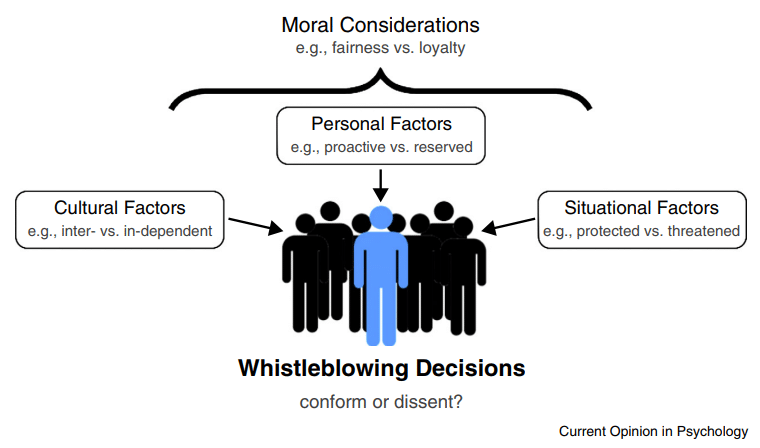
Three key factors that affect the decision to become whistleblowers
1. Personal factors
One of the strongest personal factors influencing whistleblowers is locus of control, a psychological concept describing how much individuals believe they can control the events in their lives.
Internal locus of control: People who believe outcomes are determined by their own efforts are more likely to become whistleblowers. They see wrongdoing in the workplace as something they can and should influence. Fairness outweighs loyalty, and reporting misconduct becomes a moral obligation.
External locus of control: On the other hand, individuals who believe outcomes are beyond their control often avoid blowing the whistle. They may assume that reporting will not change anything or that someone else should take responsibility.
When internal control dominates, whistleblowers are driven by a sense of responsibility and the belief that their actions can positively shape their environment. They act because fairness, the desire to uphold what is right, becomes stronger than loyalty to individuals or institutions.
For organizations, understanding this personal factor is essential. Employees who feel empowered and supported are far more likely to take action when they encounter fraud or misconduct.
2. Situational factors
Even employees with a strong sense of fairness might hesitate to become whistleblowers if their company does not provide the right support. Situational factors, particularly the presence of a clear whistleblowing system, play a decisive role.
When organizations build a culture of support, employees feel safe and encouraged to report wrongdoing. This includes:
- Raising awareness about the dangers of fraud and the benefits of whistleblowing.
- Providing accessible reporting channels, such as hotlines, secure online platforms, or third-party whistleblowing systems.
- Protecting whistleblowers from retaliation, discrimination, or career setbacks.
- Recognizing and valuing fairness, rather than treating loyalty to silence as a higher priority.
Without these situational factors, employees are more likely to remain silent even if they recognize misconduct. This is why many leading companies in Indonesia and across the globe invest in professional whistleblowing systems. Such systems provide employees with a safe, confidential, and reliable way to speak up.
For example, Integrity Indonesia offers the Canary Whistleblowing System (CWS), which ensures anonymity, multiple reporting channels, and multilingual support. By removing barriers and fears, companies can transform potential whistleblowers into active defenders of organizational integrity.
3. Cultural factors
Culture is another significant influence on whistleblowers’ decisions. Research shows that individuals from collectivist cultures, such as many in Asia (including Japan, China, and Indonesia), often view whistleblowing less favorably compared to those from individualistic cultures, like the United States.
In collectivist cultures, loyalty to the group is prioritized. Reporting misconduct may be seen as betrayal or disloyalty, especially if it involves colleagues or superiors.
In individualistic cultures, fairness and personal ethics often take precedence, making individuals more likely to act as whistleblowers.
The greater the degree of collectivism, the stronger the loyalty factor, and the more negative whistleblowing may be perceived. This cultural barrier often explains why cases of corruption or misconduct can persist undetected in organizations where group harmony is valued above transparency.
For businesses operating in Indonesia and other Southeast Asian countries, understanding this cultural dynamic is essential. It highlights the importance of educating employees that whistleblowing is not betrayal, but rather a responsible act of fairness and integrity.
Why understanding whistleblowers matters for your company
Whistleblowers are not just individuals who report misconduct. They are valuable allies in protecting your business from fraud, reputational damage, and financial loss. By recognizing the personal, situational, and cultural factors that influence whistleblowers, companies can design effective anti-fraud policies and systems.
A strong whistleblowing framework sends a clear message: fairness matters, misconduct will not be tolerated, and whistleblowers will be protected. This not only reduces risks but also strengthens trust with employees, stakeholders, and the public.
Empowering whistleblowers with the right system
Encouraging whistleblowers starts with providing them the right tools and protection. At Integrity Indonesia, we offer the Canary Whistleblowing System, a secure, multi-channel, and customizable solution designed for companies across industries.
With CWS, employees and third parties can confidently report misconduct in multiple languages, through various channels, and with guaranteed confidentiality. This not only facilitates whistleblowing but also aligns with global best practices in corporate governance.
If you want to protect your company’s integrity, prevent fraud, and empower whistleblowers, investing in a professional whistleblowing system is no longer optional. It is essential.